Relaying wakeups in fair locks
A while back, I came across kprotty’s post on Batched Critical Sections (BCS), a concurrency pattern aimed at reducing scheduler overhead in fair locks.
With a traditional fair lock, ownership is handed to a specific waiting thread. This means that after being woken, that thread still needs to be scheduled before it can make progress.
BCS took a different approach though. Instead of handing off ownership to another thread, the current owner executes updates on behalf of waiting threads before waking them.
I wanted to try something different. What if I kept the usual mutex semantics, but started waking threads before they were supposed to acquire the lock?
The idea is pretty simple. If I know which thread is going to acquire the lock several handoffs from now, why wait until then to wake it? I could just wake it ahead of time, it’d be running on the CPU before its turn. I called this idea RelayLock.
How does it work?
To start with, there are three pieces to RelayLock: a ticket lock, a spin array, and a concurrent ordered wait list.
A ticket lock maintains FIFO order and mutual exclusion using two variables: ticket and nowServing. Threads atomically claim a ticket when they arrive and wait until nowServing matches their ticket.
There’s one problem here though: everyone spins on nowServing.
This means every handoff invalidates the same cache line, even for threads that are nowhere near acquiring the lock, creating unneccessary memory traffic.
The spin array avoids this by giving each thread, determined by its ticket, its own slot to spin on. Now, a handoff only needs to update the slot belonging to the next thread, rather than making every waiter spin on the same shared variable.
So what about threads whose tickets fall outside the spin window?
This is where the ordered wait list comes in. It keeps track of threads outside the spin window and their corresponding tickets, allowing the previous lock holder to find a waiter mapped to a ticket after.
I used a variant of the Harris-Michael linked list for this. Though it doesn’t have to be a linked list; a concurrent hashmap would work as well.
Together, both structures would look something like this.
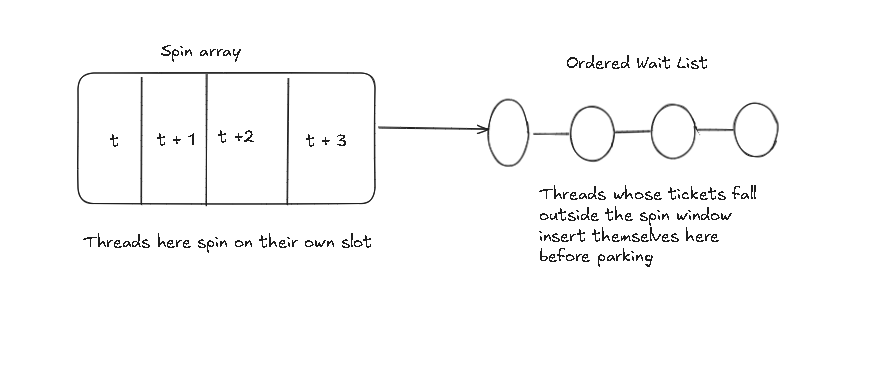
Now that we’ve gone over the main structures needed for RelayLock, the algorithm should be pretty easy to follow.
The algorithm
Acquiring the lock starts with a thread atomically claiming a ticket using fetch-and-add.
int ourTicket = ticket.nextTicket();It then checks where its ticket falls relative to nowServing to determine if it’s in the spin window.
boolean inSpinWindow = (ourTicket - nowServing) < spinArrayLength;A thread that is already within the spin window spins on its slot until it is signalled, and returns.
Slot s = spinArray[ourTicket & (spinArrayLength - 1)];
while(!s.isSignalled()) onSpinWait();
return;
Otherwise, it inserts itself into the wait list before parking. Once woken, it checks its ticket’s position relative to nowServing again. If it has entered the spin window, it removes itself from the list and starts waiting on its slot.
boolean parking = false;
for(;;) {
    if(inSpinWindow) {
        ...
        if (parking) waitList.remove(ourTicket);
        ...
    } else {
        if (!parking) {
            waitList.add(ourTicket);
            parking = true;
        } else {
            park();
        }
    }
}
Unlocking is simpler. The current owner advances nowServing by one, signals the next slot, and looks up the waiter at the back of the current spin window.
    int ourTicket = nowServing;
    var nextTicket = ourTicket + 1;
    Slot next = spinArray[nextTicket & (spinArrayLength - 1)];
    nowServing.set(nextTicket);
    next.signal(); //handoff to next waiter

    //this is the ticket that should enter the spin window after this handoff
    int lookahead = ourTicket + spinArrayLength;
    Thread waiter = waitList.get(lookahead);
If a waiter mapped to that ticket is present in the wait list, it is unparked.
//If the waiter is present, unpark
if (waiter != null) unpark(waiter);
That’s the whole algorithm.
How does it perform?
I wrote a benchmark in JMH consisting of a short and medium sized critical section to compare RelayLock against the JDK’s fair ReentrantLock, which is a variant of the CLH lock. I also included a BaselineRelayLock as a control implementation, which removes the wake ahead aspect of RelayLock.
Going in, I expected the performance of RelayLock would depend on two things: the cost of the critical section and the length of the spin array.
My reasoning was that the longer the spin window, the more time a thread has to get scheduled before it’s actually supposed to acquire the lock.
So I expected RelayLock to perform similarly to a traditional fair lock when the time needed to execute the critical section multiplied by the threads in the spin window was roughly less than the time needed for the OS to schedule a thread back onto the CPU.
However, RelayLock performed considerably better than both baselines in both benchmarks, even when the spin window wasn’t large enough to cover the scheduler overhead.
The difference between RelayLock and BaselineRelayLockwas particularly noticeable. This actually matters a lot since it shows that simply relaying wakeups ahead of time makes a substantial difference, even without a particularly large lookahead window.
The cost of the critical section also didn’t have as much impact as I expected. Both benchmarks behaved pretty similarly, with scheduler overhead still dominating the time spent waiting for the lock.
So, my initial hypothesis was pretty much wrong and you don’t actually need a relatively large spin window to get a benefit from relaying wakeups (relative to my baseline). At least for these workloads, a relatively small spin window was enough to outperform both baselines.
RelayLock ended up performing much better than I expected, but there are still some downsides. Though depends if you consider them downsides.
First, we’re waking threads that aren’t necessarily going to acquire the lock immediately. We’re moving some of the scheduling overhead out of the handoff path, but that also means having threads become runnable way before they are actually doing anything useful. Plus, threads in the spin array also never park, so they can end up burning CPU while waiting for their turn. Depending on the workload, particularly when oversubscription is common, these can become footguns.
RelayLock is definitely not a better general-purpose lock than ReentrantLock. But if fairness matters and a lock is the right primitive for the job, RelayLock is probably an interesting alternative.
The end?
Finally, if you’re interested in the actual implementation or just want to check the benchmarks, you can check that out here
Also, you can check out a more established pattern known as Flat Combining that I built and is quite similar to BCS here